Tracing Musical Crossroads
Tap your hand on a table eight times at a steady speed: one-two-three-four-five-six-seven-eight. Now tap it again, but accent only counts One, Four, and Seven: ONE-two-three-FOUR-five-six-SEVEN-eight. That asymmetrical 3 + 3 + 2 grouping is one of the most traveled rhythmic cells in human history.
In Havana and Santiago de Cuba, musicians call it the tresillo, the foundational half of the five-stroke clave pattern. In New Orleans, pianist Professor Longhair and drummer Earl Palmer called it the "second-line" or "habanera" bounce that propelled early rock and roll. In Buenos Aires, Astor Piazzolla used that exact 3-3-2 accent to drive nuevo tango, while across the Mediterranean it underpins Levantine malfuf percussion. When we follow a rhythm like the tresillo, we see that musical borders have always been porous.
Paris, 1889: When Claude Debussy Heard the Javanese Gamelan
In the summer of 1889, Paris hosted the Exposition Universelle, celebrating the centennial of the French Revolution and inaugurating the Eiffel Tower. On the Esplanade des Invalides stood a reconstructed Javanese village (kampong) featuring a complete court gamelan ensemble of bronze metallophones, tuned gongs, spike fiddle (rebab), and dancers from central Java.
Twenty-seven-year-old French composer Claude Debussy spent hours sitting in the pavilion. At the time, European conservatories taught that music had to push forward through dramatic harmonic conflict—chord A straining toward chord B until reaching a triumphant cadence. The Javanese gamelan revealed an entirely different philosophy of time: cyclic layers of bronze percussion where slow, deep gong strokes marked wide rings of time while higher metallophones wove shimmering, interlocking patterns above them.
"Javanese music obeys laws of counterpoint that make Palestrina seem like child's play," Debussy wrote to a friend in 1895. Rather than copying Javanese melodies superficially, Debussy absorbed their architecture into works like Pagodes (from his 1903 piano suite Estampes) and La Mer: he used five-note pentatonic and six-note whole-tone scales that floated without traditional harmonic gravity, holding low piano bass notes with the sustain pedal to imitate the long decay of a great bronze gong.
The Atlantic Loop: How Cuban Son Sparked Congolese Soukous
Few exchanges illustrate musical migration more vividly than the 20th-century dialogue between Havana and the Congo River basin. During the transatlantic slave trade, Central African rhythmic patterns, thumb-piano patterns, and vocal call-and-response were carried to the Caribbean, where they blended with Spanish plucked guitars (tres) to form Cuban son.
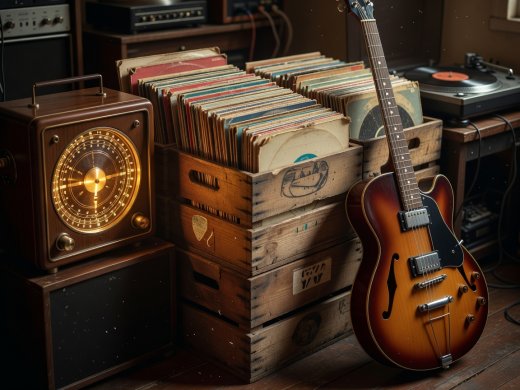
In the 1930s and 1940s, the British gramophone company HMV pressed a series of 10-inch shellac records labeled simply "G.V." (from Gramophone Victor), featuring Cuban groups like Trio Matamoros and Sexteto Habanero. Merchant ships carried crates of these GV records to West and Central African ports, including Léopoldville (Kinshasa) and Brazzaville.
Congolese listeners didn't even need to understand the Spanish lyrics; the rhythmic feel felt immediately familiar. Pioneers like Wendo Kolosoy, Grand Kallé (Joseph Kabasele), and guitar wizard Franco Luambo Makiadi began singing in Lingala over the Cuban rumba pulse. When they swapped the Cuban horn and piano parts onto electric guitars plugged into tube amplifiers, they invented the sebene—the high-energy instrumental middle section of a Congolese rumba song where two or three guitars weave glassy, cyclic sixteenth-note lines that later influenced guitar styles from Nairobi to Cartagena.
Crossroads Timeline: Five Borrowings That Built New Sounds
1830s · Mexican Vaqueros and Hawaiian Kī Hōʻalu (Slack-Key Guitar)
King Kamehameha III invited Mexican cowboys (vaqueros) from California to Hawaii Island in 1832 to teach cattle ranching. After work around campfires, the cowboys played Spanish guitars. Hawaiian musicians kept the instruments after the vaqueros departed, loosening ("slacking") the six strings until open strums formed rich major chords like the famous Taro Patch (Open G) tuning—allowing the thumb to play a steady alternating bass while the fingers chimed the melody.
1920s · Hawaiian Steel Guitar Reaches Nashville and Mumbai
Oahu schoolboy Joseph Kekuku discovered in the 1880s that sliding a smooth piece of metal along raised guitar strings produced a singing, vocal sustain. Touring Hawaiian troupes carried this sound across North America, where it became the pedal steel guitar of country music and the bottleneck slide of Delta blues—and on to India, where Pandit Brij Bhushan Kabra and Vishwa Mohan Bhatt adapted the slide guitar (creating the 20-string Mohan veena) to perform classical Hindustani ragas.
1958 · Bossa Nova Whisper in Rio de Janeiro Apartments
In the beachside apartments of Copacabana and Ipanema, guitarist João Gilberto and composer Antônio Carlos Jobim stripped the thunderous street carnival percussion of Brazilian samba down to a single nylon-string guitar thumb-and-finger pattern (violão gago or "stammering guitar"), blending it with the cool, close-voiced jazz harmonies of West Coast arrangers like Gerry Mulligan and Chet Baker.
1968 · Peruvian Chicha: Andean Huayno Meets Surf Reverb
In Lima and the oil town of Moyobamba, bands like Los Destellos and Los Mirlos plugged electric guitars into dripping spring-reverb amplifiers inspired by The Ventures, combining Colombian cumbia percussion with the pentatonic mountain melodies of Andean huayno folk music.
1972 · Ethio-Jazz in Addis Ababa's Nightclubs
Vibraphonist and arranger Mulatu Astatke returned to Ethiopia after studying at Trinity College of Music in London and Berklee in Boston. By pairing traditional five-note Ethiopian modes (such as Tizita and Bati, which have a haunting, nostalgic interval structure) with wah-wah guitars, Latin conga patterns, and smoky saxophone harmonies, he created the unmistakable sound of 1970s Addis Ababa.